Monday, December 9, 2013

Challenges and Opportunities

What is human activity doing to our planet?

Is it destruction? Or damage? Or merely an acceptable alteration?

For the sake of our children, and grandchildren, and their children and grandchildren, etc., I think we must ask these questions. I also think that we must reach our own answers.

In reaching your answer, here's some information worth considering:
  • Rising CO2 leads to rising temperatures. Rising temperatures will likely lead to enormous problems by creating a world that will have less predictable weather patterns, more droughts and floods, more frequent and severe disruptions to agriculture, more extreme weather events, more habitat for disease-carrying insects, more loss of biodiversity, more human migration, displacement, and refugees, etc. (4)
But climate change (i.e. global warming) is only one part of the story.

When I consider all of this together, it definitely feels like damage, or perhaps even destruction, would be the right words to describe what we are doing to our planet.

I wonder, 'What might all this mean in 10 or 20 or 30 years, when our children or grandchildren will be reaching adulthood, or beginning families of their own? What kind of world might they find waiting for them? How might such a world impact their ability to be happy, fulfilled, joyful, or perhaps even safe, healthy and well fed?'

I think that all adults in the world today have a moral imperative to think deeply about these kinds of questions. The world we leave to our children should be our responsibility and our burden, not theirs. And if we accept that responsibility, then it certainly seems like we have some pretty extraordinary challenges ahead of us.

And yet, I am optimistic. The problems facing the world are significant, but so, too, is human ingenuity and creativity. So, too, is human compassion, kindness and generosity. Facing these problems will bring out the best in us individually and collectively, and it may even have the potential to lead us to the birth of a new era of human history, marked by greater international cooperation, sharing of power, and harmony with nature.

Wouldn't that be an amazing gift to leave for future generations...

So what can we do now? So many things! I want to hear other peoples' ideas. Here are a few of mine:
  • Consume wisely, i.e try to buy things that are: 
    • Produced by people being paid a fair wage (i.e. Fair Trade)
    • Free of (or low in) toxic chemicals
    • Easy on the environment when produced, when used and when thrown away
    • And, of course, consume less! Have more experiences and fewer things!
  • Support organizations (w time and/or money) that are doing positive work that you believe in
  • Spend more time in nature. Connect children with nature.
  • Educate yourself and others about important issues (human rights, ecology, environmental protection, child welfare, etc.)

This is just the tip of the iceberg. There really seems to be SO MUCH that we can do to help move the world in a better direction.

Let's all listen to our hearts' guidance. Let's allow our actions in the world to be guided by kindness and generosity. If we can do this, I believe our actions will be good. Good for us personally and good for mankind and good for the Earth.


-----------------------
References:
(1) Climate change consensus: http://climate.nasa.gov/scientific-consensus
(3) CO2 levels forecast to increase for decades: http://www.eia.gov/forecasts/ieo/

Friday, June 26, 2009

Growing Veggies (Update)

On May 26, I posted about "Growing Veggies." At that time, the garden was just starting to take shape and nothing was ready to be eaten. What a difference a month makes...

This was taken a few days ago:

In the front right, with the yellow flowers, is zucchini. Immediately behind that is daikon, and behind that is sweet peppers, chili peppers, basil and goya (aka bitter melon). To the right of goya is corn and cauliflower. To the left of the zucchini is a row of morning glory (aka water spinach), the dark green chijimina (similar to bok choy) and behind that is more morning glory. To the left of that row is eggplant, tomato, cucumber and spinach (in the back).

Here is Ayumi with a few days worth of zucchini:


Here's another angle on the veggies:

From front to back: spinach; water spinach; (L to R) goya, basil, chili pepper, sweet pepper; corn and one of the eight cauliflowers.

This has been an awesome experience for me. Watching the plants grow has been magical. And it's a wonderfully enjoyable culinary experience to pick fresh, pesticide- and herbicide-free plants outside your home and to be eating them within the hour. For one, the food tastes great--fresh, delicious, full of life. But also, it's very gratifying to be feeding ourselves food that we know is so healthy.

And it was really pretty easy to do. In fairness, my father-in-law, an experienced grower, was doing all this with us, so that helped. But it was all fairly straight-forward. This is what went into it:

First, my father-in-law used a machine to mix up the soil and plow it into rows. Ayumi and I then spent a few hours forming the rows and smoothing the surface. My father-in-law then applied small amounts of chemical fertilizer (he composts, but the compost was not sufficient by itself--in the future, I hope to learn how to grow veggies 100% organic) and we waited a week. Then we planted seeds and seedlings. We've watered them daily since then. Once every few weeks we've had to pull out weeds by hand. And a few times we sprayed charcoal vinegar (a natural insecticide) to discourage some little bugs who were eating the young zucchini and chijimina leaves. So it hasn't really taken up that much time, and what time we have spent (watering, weeding, etc.) has been really enjoyable and relaxing.

It's about 6pm here, the sun has just gone down below the hills behind the house, so it's time to water the plants. Then I'll harvest something for dinner. I think tonight we'll use moning glory, chijimina and zucchini. Mmmm.....

Monday, June 15, 2009

Food Inc.

"The way we eat has changed more in the last fifty years than in the previous ten thousand."

This is the opening line of a new documentary on how food is produced in the United States, focusing particularly on the industrial food system. I've touched on this issue in previous posts (see: "Support Organic", Dec. 19, 2008; "Organic: Good for Earth", Feb. 3, 2009), and I think it is extremely important.

The way we in the industrial world produce food is unsustainable, destructive to the environment and yields food of dubious nutritional value whose main virtue is that it's cheap. This system is excellent economically (at least if you don't take into account the money spent treating obesity, diabetes, heart disease, etc., and the costs of pollution of streams, rivers, lakes, the Gulf of Mexico, the air, etc.) but it is terrible in every other way. It persists, I believe, primarily because most people don't know the facts about it. If every person in the United States spent just one single day educating themselves about how our food is produced, that would be enough to bring about massive changes. The facts are powerful and overwhelming.

At least that's how it looks to me. You might disagree. But either way, you owe it to yourself to be informed, because this issue is so important and so universal. This film looks like a great place to start.

Here is their excellent website, which is loaded with information: http://foodincmovie.com/

And here's the trailer:

Wednesday, May 27, 2009

Growing Veggies

What better way to reconnect with the land than to grow food! For years, I've been looking for an opportunity to grow some veggies, and this summer, living with my wife Ayumi's family in Japan, it's finally come. The city where we're living, Hofu (in Yamaguchi state), is fairly rural and many, many people grow their own vegetables, right out in their front yard. It's inspiring to see.

Ayumi and I have planted seeds for zucchini, ensai and chijimina (don't know the English names for the last two!). We're also helping her parents grow spinach, tomatoes, potatoes, onions, eggplant, okra, cucumber, bell peppers, chili peppers, goya (a Japanese vegetable), daikon (Japanese radish), lettuce, parsley, basil, garlic, koimo (a Japanese starch veg, similar to potato), watermelon and shiso (a Japanese herb).

There's something really magical about putting a tiny little seed into the ground and then watching the delicate buds push their way up and out through the soil, growing day by day into a big plant. Here are some pictures of what we've got so far:

April 27: Seeds for zucchini, ensai and chijimina have just been planted. Ayumi, in pink, surveys the land, while her mom, in blue, pulls weeds. The bubbles house young eggplant, tomato and cucumber plants.


May 2: Zucchini (top) and chijimina (bottom) are starting to emerge.


May 12: More sprouts emerging. Eggplant, tomato and cucumber are out of their bubbles. Starting to look like a real garden now.


May 22: Chijimina is starting to look like a real plant, though many of the seeds never sprouted, so we planted some more. Ensai, past the dark green chijmina, is having trouble (I think we planted the seeds too deep--learning as we go!), so we planted some more seeds. On the right are the zucchini. Behind them is the daikon.


May 27 (today): The zucchini (first pic) are starting to get big. Even the ensai (second pic) are growing well now. The garden is getting greener every day.


Monday, April 27, 2009

Journey to the Ants

As I like to learn more about the other creatures with whom we share this planet, I recently read a book about ants, Journey to the Ants, by Bert Holldobler and Edward O. Wilson. It's a 200-page adaptation for the general public of their 700+page 1991 Pullitzer Prize-winning tome, Ants.

Ants are fascinating! Although they are tiny little creatures, they engage in a wide variety of intelligent, complex behaviors that we typically associate only with humans. For example, many ant colonies intentionally wage wars against neighboring ant colonies. First, they send out scouts who locate the enemy. After marking the enemy's location, the scouts return to the nest for reinforcement by the 'soldiers,' who are larger ants of the same species that are more aggressive and better suited for fighting (check out this picture--the solider is on the right--notice the spikes on his back--yikes!). Then they pour out en masse and swarm the enemy. In addition to waging wars, some ants make raids of other ant colonies not to fight a big battle but to steal in and take hostages that they will turn into slave laborers.

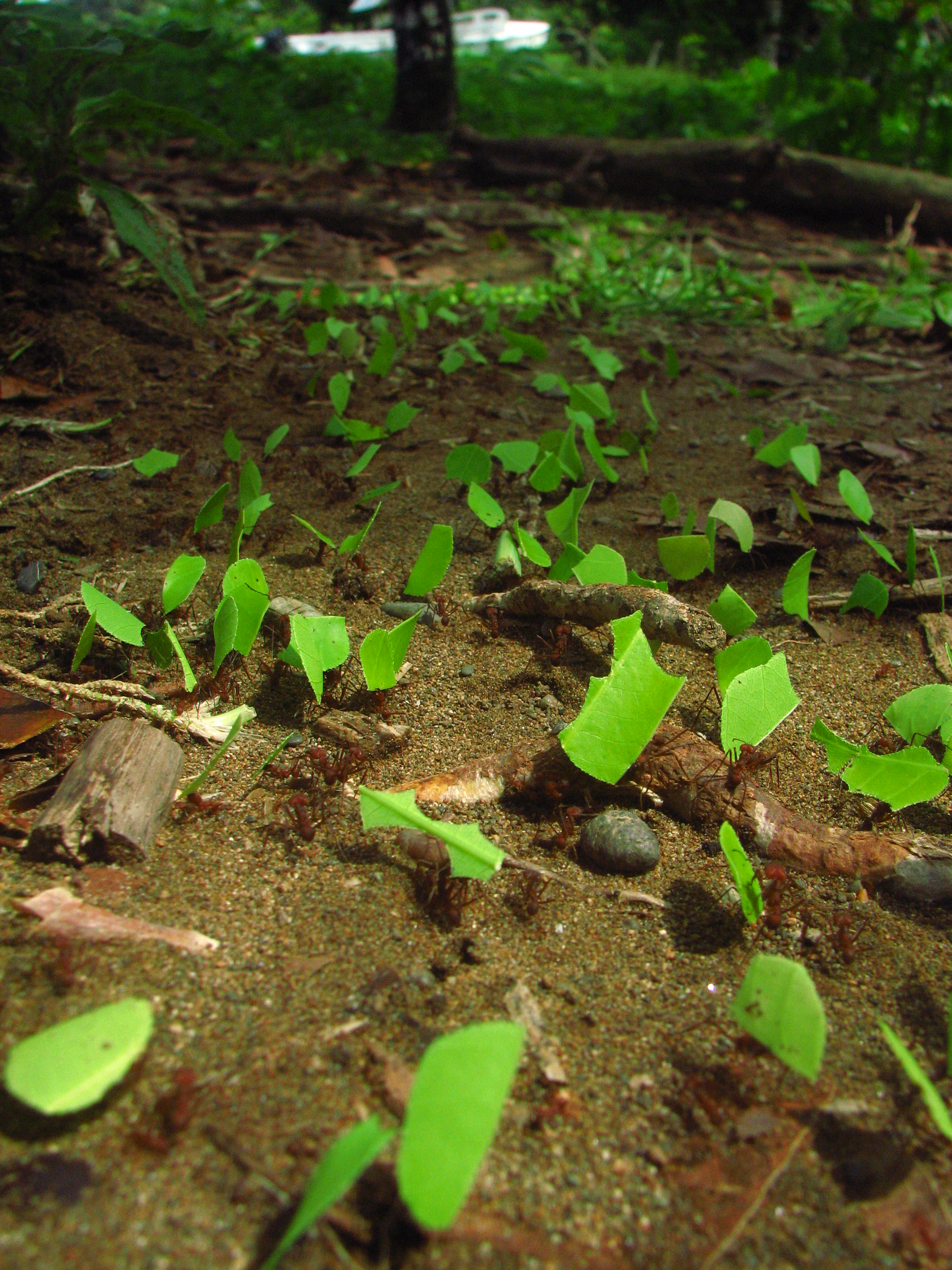
Some types of leafcutter ants are gardeners. They cut up pieces of fresh leaves and take them back to their nest. They chew up the leaves and then use the paste as a fertilizer on which they grow fungi that is their main food source. Other types of ants are farmers, tending 'cattle' in the form of aphids (small insects). The ants guard the aphids and continually move them to fresh areas of plant growth, which the aphids eat. The aphids then give off a sugary secretion which the ants eat. Stunning to find such multi-step intelligence from such tiny creatures. And these are just a few of many examples from the ant world. If you're at all curious about ants, I highly recommend this book.

Wilson and Holldobler, aside from being two of the most respected myrmecologists in the world, are also very thoughtful writers. Their final two paragraphs offer some humbling perspective on the respective roles that humans and ants play for life on Earth:

"If all of humanity were to disappear, the remainder of life would spring back and flourish. The mass of extinctions now under way would cease, the damaged ecosystems heal and expand outward. If all the ants somehow disappeared, the effect would be exactly the opposite, and catastrophic. Species extinction would increase even more over the present rate, and the land ecosystems would shrivel more rapidly as the considerable services provided by these insects were pulled away.

Humanity will in fact live on, and so will ants. But humankind's actions are impoverishing the earth; we are obliterating vast numbers of species and rendering the biosphere a far less beautiful and interesting place for human occupancy. The damage can be fully repaired by evolution only after millions of years, and only then if we let the ecosystems grow back. Meanwhile let us not despise the lowly ants, but honor them. For a while longer at least, they will help to hold the world in balance to our liking, and they will serve as a reminder of what a wonderful place it was when first we arrived."

Wednesday, March 11, 2009

Carbon Calculations and Offsets

While I think it's important to reduce our use of fossil fuels, we still live in a society that is entirely dependent on those fossil fuels. And we have to live our lives. This means that sometimes we are going to do things that are not ideal environmentally.

Case in point: this autumn, I'll move somewhere to begin graduate school, and I think it's important to see the schools and their surrounding areas before making the decision of where to go. I love road trips, so my first thought was to go by car. But that struck me as a lot of fuel to use up for one person.

My next thought was trains. I love long train trips, which often pass through amazingly beautiful places that you can't get to on roads. But after spending some time on Amtrak.com, I found that the trains are longer than I had thought--the longest would be about a 72 hour trip. Yikes!

So then I checked planes, which turned out to be the fastest and cheapest option by far. Definitely not as fun as trains, but when you can pay $200 (not including food) for 72 hours on a train or $110 for 6 hours on a plane, it's tough to choose the train.

But aren't planes terrible for the environment? I wanted to know what my carbon footprint would be with these various forms of transportation.

I ended up at CarbonFootprint.com, where I was able to calculate the carbon footprint of my potential itineraries. (They state that their US data comes from the Environmental Protection Agency and the Department of Energy.)

Here was the breakdown of doing the trip by:

Train = 1.06 tonnes of CO2

Plane = 1.14 tonnes of CO2

Car = 3.66 tonnes of CO2

I was a little bit surprised by how much worse car is than the others (though it wouldn't be so bad if I wasn't going solo). But what really surprised me most was that plane and train were so similar. I've always thought of trains as being much better, but apparently they're only a little better.

Looking at these numbers, I think I'll probably take two planes and a train. But that will still leave me producing about 1.16* tonnes of CO2. What about that? (*This is higher than the 1.14 above, because the train I'll take, Denver to Seattle, is actually slightly more carbon than the same route by plane, because it goes all the way west to Sacramento before going north.)

I originally went to CarbonFootprint.com to calculate my carbon emissions, but it turned out that their main function is selling carbon offsets. "Carbon offset" means that I donate to an organization whose activities will reduce CO2 by roughly the same amount that my activities have increased CO2. The idea behind this is to generate funding for organizations that are doing good things for the environment and to create a market for carbon offsets that will provide a financial incentive for companies to lower their CO2 emissions.

So my 1.16 tonnes of CO2 have been offset by $14.84 given to an organization that is planting Maya Nut trees to reforest parts of Central America. Pretty neat.

Btw, in case you, like me, have an inner cynic, and wonder how we can know that the $14.84 will actually go towards planting trees, it seems there are efforts underway to regulate the carbon offset industry. For example, the British government has started a program to oversee and certify carbon offsetters, the Quality Assurance Scheme for Carbon Offsetting, and CarbonOffset.com is one of the first to receive approval. For more on purchasing carbon offsets, check out this great wiki: How to Buy a Carbon Offset.

The idea of carbon offsets is relatively new, and nobody really knows yet if it will work. There are certainly strong opinions on both sides of the matter. The Wikipedia entry on the subject gives a good overview: http://en.wikipedia.org/wiki/Carbon_offsets.

For my part, I like this first experience. It's something of an easing of my conscience for the emissions of my travel, which is kind of selfish, but it also invests money in what are hopefully good projects. And it provides incentive for us to be more aware of how our actions emit CO2 and to do something positive about it.

If you want to give it a try, here's the flight portion of the carbon calculator from CarbonFootprint.com. The full version is here.

Monday, March 9, 2009

The Great Disruption

This is an excellent opinion piece from the New York Times. Perhaps we are collectively, on the level of the "mainstream," starting to understand how serious our problems are.

The Inflection is Near?


Published: March 7, 2009

Sometimes the satirical newspaper The Onion is so right on, I can’t resist quoting from it. Consider this faux article from June 2005 about America’s addiction to Chinese exports:

FENGHUA, China — Chen Hsien, an employee of Fenghua Ningbo Plastic Works Ltd., a plastics factory that manufactures lightweight household items for Western markets, expressed his disbelief Monday over the “sheer amount of [garbage] Americans will buy. Often, when we’re assigned a new order for, say, ‘salad shooters,’ I will say to myself, ‘There’s no way that anyone will ever buy these.’ ... One month later, we will receive an order for the same product, but three times the quantity. How can anyone have a need for such useless [garbage]? I hear that Americans can buy anything they want, and I believe it, judging from the things I’ve made for them,” Chen said. “And I also hear that, when they no longer want an item, they simply throw it away. So wasteful and contemptible.”

Let’s today step out of the normal boundaries of analysis of our economic crisis and ask a radical question: What if the crisis of 2008 represents something much more fundamental than a deep recession? What if it’s telling us that the whole growth model we created over the last 50 years is simply unsustainable economically and ecologically and that 2008 was when we hit the wall — when Mother Nature and the market both said: “No more.”

We have created a system for growth that depended on our building more and more stores to sell more and more stuff made in more and more factories in China, powered by more and more coal that would cause more and more climate change but earn China more and more dollars to buy more and more U.S. T-bills so America would have more and more money to build more and more stores and sell more and more stuff that would employ more and more Chinese ...

We can’t do this anymore.

“We created a way of raising standards of living that we can’t possibly pass on to our children,” said Joe Romm, a physicist and climate expert who writes the indispensable blog climateprogress.org. We have been getting rich by depleting all our natural stocks — water, hydrocarbons, forests, rivers, fish and arable land — and not by generating renewable flows.

“You can get this burst of wealth that we have created from this rapacious behavior,” added Romm. “But it has to collapse, unless adults stand up and say, ‘This is a Ponzi scheme. We have not generated real wealth, and we are destroying a livable climate ...’ Real wealth is something you can pass on in a way that others can enjoy.”

Over a billion people today suffer from water scarcity; deforestation in the tropics destroys an area the size of Greece every year — more than 25 million acres; more than half of the world’s fisheries are over-fished or fished at their limit.

“Just as a few lonely economists warned us we were living beyond our financial means and overdrawing our financial assets, scientists are warning us that we’re living beyond our ecological means and overdrawing our natural assets,” argues Glenn Prickett, senior vice president at Conservation International. But, he cautioned, as environmentalists have pointed out: “Mother Nature doesn’t do bailouts.”

One of those who has been warning me of this for a long time is Paul Gilding, the Australian environmental business expert. He has a name for this moment — when both Mother Nature and Father Greed have hit the wall at once — “The Great Disruption.”

“We are taking a system operating past its capacity and driving it faster and harder,” he wrote me. “No matter how wonderful the system is, the laws of physics and biology still apply.” We must have growth, but we must grow in a different way. For starters, economies need to transition to the concept of net-zero, whereby buildings, cars, factories and homes are designed not only to generate as much energy as they use but to be infinitely recyclable in as many parts as possible. Let’s grow by creating flows rather than plundering more stocks.

Gilding says he’s actually an optimist. So am I. People are already using this economic slowdown to retool and reorient economies. Germany, Britain, China and the U.S. have all used stimulus bills to make huge new investments in clean power. South Korea’s new national paradigm for development is called: “Low carbon, green growth.” Who knew? People are realizing we need more than incremental changes — and we’re seeing the first stirrings of growth in smarter, more efficient, more responsible ways.

In the meantime, says Gilding, take notes: “When we look back, 2008 will be a momentous year in human history. Our children and grandchildren will ask us, ‘What was it like? What were you doing when it started to fall apart? What did you think? What did you do?’ ” Often in the middle of something momentous, we can’t see its significance. But for me there is no doubt: 2008 will be the marker — the year when ‘The Great Disruption’ began.

Wednesday, March 4, 2009

Awakening the Dreamer

This past Sunday, I attended the Awakening the Dreamer symposium at Power Shift 2009. It was a great experience.

The framework for the symposium was a look at four questions: Where are we? How did we get here? What's possible for the future? Where do we go from here?

These questions were examined with video clips, speakers and individual and group activities and contemplations. It was informative, entertaining and inspiring.

The best aspect for me was the deep sense of connection it gave me with other people who are equally concerned about the state of the planet and equally committed to doing something about it. Usually, I feel like a voice in the wilderness, because the vast majority of the people I know seem barely or not-at-all concerned. And the problems we face are so massive that a lone voice in the wilderness is not enough. It's hard to remain hopeful sometimes. But this symposium left me feeling that I was just one tiny part of a growing and immensely powerful movement. It gave me a tremendous sense of hope and optimism.

I can't recommend it enough!


Saturday, February 28, 2009

A Better Way to Wipe

Apparently, people in the United States have delicate bottoms.

According to this article in the New York Times, "Mr. Whipple Left It Out: Soft Is Rough on Forests," Americans have a particular preference for soft, fluffy toilet paper that can only be made using new trees (i.e. non-recycled materials). Many of these trees come from tree farms in South and North America, and some of them come from virgin forests that are home to numerous endangered species. In addition to this loss of trees, the process of making tissue papers from freshly cut trees is also more chemically polluting than when using recycled materials.

If you stop and think about it, this is truly ridiculous. We are cutting down trees, including virgin forests, so that we can have a slightly softer toilet experience. Is this not more egregious than just about any other form of waste in our society? Talk about unnecessary. Future generations will lambaste us (rightly) for this.

But let's not berate ourselves too harshly. After all, the manufacturing process of toilet paper is not something that we learn at school. I didn't really know about all this stuff myself until this morning when I came across that article, and I have Charmin Ultra Soft (very soft, very fluffy) in my bathroom right now. But next time I go shopping, I'm going to buy something better.

For some ideas on what's better, check out this Recycled Tissue and Toilet Paper Guide from Greenpeace--which, by the way, lists not only toilet paper, but also facial tissues, paper towels and paper napkins, because it's really all of our paper products that we're talking about here. Is it any less ridiculous to unnecessarily cut down trees to blow your nose, clean up a spill or wipe your hands than it is to wipe your bum softly?

The reality is that most human beings don't use toilet paper at all. (I've traveled in India, and I can tell you that it's really not a big deal to splash with water and then wash your hands afterwards.) But of those who do, most use toilet paper this is partly or entirely from recycled paper.

So let's give up our extra soft and fluffy squares and switch over to 100% recycled products. We have no right to wipe our ass with a forest.

Friday, February 13, 2009

Breathing Earth

This site is very interesting.  It really gives you a sense of what's happening with population growth and co2 emissions on a global scale.  

Also very interesting, seeing the frequency of births and deaths, to sense the stream of life flowing continuously through our world.

(scroll down on the Breathing Earth page for more information and some great links)

Tuesday, February 3, 2009

Organic: Good for Earth

Let's look a little bit more closely at how the industrial agricultural system and the organic farming movement relate to the environment.

According to the United States Geological Survey (USGS), approximately 1 billion pounds of synthetic pesticides are used in the United States every year.  There is a growing body of evidence linking these synthetic pesticides with serious health problems for both humans and animals.  It is estimated that at least 67 million birds are killed each year on U.S. agricultural land from exposure to pesticides.  There also seems to be a link between pesticides and global declines in frog populations.  Ditto for global declines in bee populations.  If we think about it, this makes sense: the purpose of pesticides is to kill--they are quite literally chemicals of death.  So why should we be surprised that putting 1 billion pounds of them into the environment annually causes animals to die?

The USGS also states that 28 billion pounds of synthetic fertilizers are used each year in the United States.  A large proportion of that total is not absorbed by the soil and plants but is instead carried by rains into streams, lakes and rivers, from which it eventually makes its way to the ocean.  One example of this is the Gulf of Mexico 'dead zone.'  Each year, spring rains brings synthetic fertilizers from croplands in the American Midwest into the Mississippi river and out into the Gulf of Mexico.  The nitrogen in the fertilizers disrupts the ecosystem of the gulf, starting a chain reaction that leads to oxygen depletion.  The result is a stretch of ocean that is "as barren as the surface of the moon," containing no fish, no shrimp, no crabs, no life at all.  In 2008, the dead zone was over 8,000 sq. miles, which is roughly the size of New Jersey.  Does this not scream that there's something wrong with how we're doing things?

Organic farming offers an alternative to these problems.  While our industrial agricultural system uses 28 billion pounds of synthetic fertilizers annually, organic farming uses zero pounds of synthetic fertilizers.  Instead, crops are grown in such a way (crop rotation, composting, animal waste as fertilizer) that the soil restores itself naturally and runoff is greatly reduced.

And while our industrial agricultural system dumps 1 billion pounds of laboratory-created poison onto our fields each year, organic farming uses significantly smaller quantities of significantly less toxic, natural pesticides.  For the most part, pests are controlled by supporting natural ecosystems and the creatures that prey on the pests.  Pesticides become mostly unnecessary.

So what are the criticisms of organic farming with regards to the environment?  Some people, particularly those connected to agribusiness corporations, contend that organic farming is less productive than industrial agriculture and that in order to feed the planet through organic farming, we would have to bring more land under cultivation by cutting down more forests.  I am not a farmer, so I cannot claim to tell you through my personal experiences whether or not this is true.  However, a 22-year study by the Rodale Institute and Cornell University found that "organic farming produces [the] same corn and soybean yields as conventional farm[ing], but consumes less energy and no pesticides." The general consensus outside of the agribusiness community seems to be that organic farming can be every bit as productive as industrial farming in the short-term, and it's likely more productive in the long-term when sustainability issues (such as soil degradation) are taken into consideration.  

So it seems that any way you look at it, organic is better for the environment.  And my common sense tells me the same thing.  In sharp contrast to our current methods of agriculture, organic farming exists in harmony with and strengthens ecosystems.  And it is sustainable and healthy for all life on the planet.  So let's support our natural environments by supporting the organic movement.

Saturday, December 20, 2008

Support Organic

Organic products are becoming increasingly popular. In 1980, the organic food market in the United States was $178 million, but by 2003 it had grown to $10 billion, and it is estimated to be $23 billion for 2008. Organic food is clearly becoming very popular and with good reason. But many people still seem to think of organic as a fad for the excessively health-conscious or the wealthy, not something for the everyman.

In fact, for virtually the entire 10,000 year history of human agriculture, farming methods have been "organic." Modern industrial agriculture (i.e. "non-organic" farming, relying on synthetic fertilizers and synthetic pesticides) is a product primarily of the 20th century. Organic food--meaning food that does not contain synthetic fertilizers, synthetic pesticides, growth hormones or antibiotics--is what all food was before industrial agriculture. So probably it's more accurate for us to think of industrial agriculture as the fad.

While all food was "organic" prior to industrial agriculture, the organic movement--and use of the term "organic"--began in the early 20th century, in response to the new methods and philosophy of industrial agriculture.

Around the time of World War I, advances made by German scientists Fritz Haber and Carl Bosch led to the development of synthetic fertilizers. Then in the 1940's and 1950's, chemicals developed for World War II were converted into synthetic pesticides. These synthetic fertilizers and synthetic pesticides allowed farmers to increase yields and profits. They also changed the structure of agriculture, favoring large-scale "monocropping" to small-scale, crop-rotating family farming. During the second half of the 20th century, industrial agriculture became the norm in the United States and other industrialized countries.

As this was happening, some looked on and didn't think it was such a good thing. Perhaps these synthetic chemicals should not be mixed into the human food supply or put into the soil. Perhaps treating the farming process like a machine or a factory was not in harmony with the principles of life and ecology. Perhaps these new farming techniques produced short-term gains at the cost of long-term health, for both humans and the planet.

Such concerns led to the emergence of the organic movement, emphasizing sustainable farming that is in harmony with nature. Organic farming creates soil fertility by rotating crops and applying manure and plant compost. Organic farming keeps away pests by attracting insects that prey on the pests and by growing plant strains that are well-adjusted to local conditions. Organic farming seeks to exist in harmony with native plants and animals. Organic farming is above all sustainable, creating an environment that is healthy and balanced--for humans, animals and the planet--and will continue to be so indefinitely.

In the United States, fruits and vegetables labeled "Organic" must: have been produced without the use of synthetic fertilizers or synthetic pesticides; not be genetically modified organisms (GMO).

Animal products, such as meat, dairy and eggs, labeled "Organic" must come from animals who: were given only organic food; were not given growth hormones; were not fed antibiotics; had access to the outdoors; and were not genetically modified organisms.

For more information about the requirements for organic products, check out this FAQ from the Organic Trade Association. And for more information about the organic movement, check out this page from Sustainable Table.

There are many great reasons to support the organic movement and to buy organic products. In the next post, we'll look at one of those reasons more closely.

Friday, November 21, 2008

The Beauty of Nature

Before I get any farther into this blog, I want to make clear that I am not an expert in 'going green.' I'm just an ordinary guy who's trying to change his bad habits into better ones. I grew up in a big city in a very wasteful, environmentally destructive culture. But as an adult, I've traveled a bit and visited places--rain forests, deserts, oceans, coral reefs, mountains, caves--that the human world has not yet overtaken. And they're beautiful--deeply, inexplicably, mysteriously beautiful. Even the most gifted poets the world has ever seen cannot capture this extraordinary beauty in words, so I won't try. But I can say that destroying what remains of these places would be the greatest tragedy in human history. Our existence as a species may or may not be able to go on after that, but I'm convinced that our spirits would be forever broken.

Maybe you already know what I'm talking about. But if not, you might be able to get a sense of it by spending some time, the more the better, in nature.

Try to get as far away as you can, some place where you won't be able to hear a single man-made sound. If you live in the United States, there's a very good chance that you have a National Park or a National Forest within several hours drive of your home (this will be carbon well used!).

If you're up for it, hike out into the park and spend the night in a tent. Or go for a long day-hike. But just make sure to get away from the roads and the visitors' centers. Get out of the World of Man and into the World of Nature.

And when you're there, don't do too much, don't read books, don't spend all your time talking. Just be there, silently, senses fully open, taking in everything around you. Breathe deeply. Listen to every sound. Smell the flowers, the breeze. Look all around you, both near and far. Touch the trees, the rocks, the earth. Soak it all in, feel it deeply. Watch a sunset or a sunrise. If you're lucky, you'll get to see some of the creatures living there, as a guest in their home.

If you can't visit a large natural area, such as a National Park or Forest, then make do with some woods or a park near your home or office. Turn off your mobile and your ipod, close your books and sit silently. Watch the trees move in the breeze, hear the conversations of the birds, notice how the suns' rays drape over it all. Turn down the volume on your thinking, turn up the volume on your sensations and just feel your environment.

There's no substitute for direct experience, but watching documentaries about Earth's natural places can also help to connect us more deeply. A great place to start is the amazing Planet Earth series.

Aside from being enjoyable and good for our physical and mental health, it's so important that we take the time to experience nature, so that we can understand exactly what it is that we're losing. When we really get it, when we really connect with nature and experience its beauty in our heart, then it's impossible not to become an environmentalist. And if we are going to make the changes that must be made to save the ecosystems of this planet and to save our own species, we'll all have to become environmentalists very soon.

Thursday, November 6, 2008

Take a Walk

America is a driving culture. We drive everywhere. Sometimes we even get in the car to drive a few blocks, as though we were allergic to walking. But going for a walk can be really pleasant.

My grandmother lives about 3.5 miles from me. Sometimes I drive there, and sometimes I walk. This past weekend, I walked. It took about one hour and twenty minutes each way, compared to fifteen minutes each way driving. But the walk was great.

It was a beautiful autumn day. I enjoyed the incredible colors of the leaves, the fresh air, the songs of birds, the darting to and fro of squirrels hiding acorns, the feeling of the sun on my skin, the sounds of the city, the people I passed. I got some good exercise. I had some quiet time to myself to do some thinking. I took photographs. On the way back, I listened to music. It was a relaxing, refreshing way to spend an afternoon. And I didn't use any gasoline.

Of course, driving seven miles doesn't exactly create an enormous amount of pollution. But it does create some, and every little bit we can reduce helps. Plus, if everybody cut out a little, it would add up to a lot. And, perhaps most important, if we start walking or riding a bike, even just a little, even just once in a while, our mentality starts to change. And as our mentality changes, our waste of energy and our creation of pollution start to decrease dramatically.

And anyway, the walk was much more enjoyable than the drive would have been. Here are a few of the pictures:


Thursday, October 30, 2008

Buy Local

Most fruits and vegetables at supermarkets in the United States are grown in California, Florida or Washington, which means that they're doing a lot of traveling from earth to mouth. Sometimes it's unavoidable, as not all places are as fertile as those three states. But often, the same fruits and vegetables that are shipped to us from afar are being grown nearby. This creates an enormous amount of unnecessary pollution that we can greatly decrease by buying local.

In addition to decreasing pollution, buying local also supports small farmers and strengthens rural communities. And local foods are probably going to be fresher, which is one reason that many people believe local foods taste better and are healthier.

There are many ways we can eat more locally produced foods. One is to shop at farmer's markets, where local farmers sell their goods directly to consumers. Another way is to buy directly from farmers. Localharvest.org is a great resource in this, linking consumers with "farmer's markets, family farms and other sources of sustainably grown food" throughout the U.S.

Another option is to participate in Community Supported Agriculture (CSA). In CSA, a group of consumers partners with a local farm. They pay a lump sum to the farmer at the start of each season and then receive regular deliveries of fruits, vegetables, dairy, meat, etc. to be picked up at a central location. This system supports local farms, provides consumers with fresh goods and links consumers more closely to the land and to farmers. For more information about CSA, go here. For a list of CSA groups in the U.S., go here.

Another way to buy local foods is to look for them at the grocery store. Some stores, such as Whole Foods, have signs indicating which items were produced locally. If our local store doesn't do this, we can ask them to start.

And when we're trying to buy local at the supermarket, it's important to keep in mind what's in season, because if it's not in season, but it's available, then it must be coming from some place far pretty far away. For a list of what's in season where you live, go here.

Buying local is a big issue for food, but it's not just food. Anything that we can buy locally reduces the pollution costs of long-distance transportation. And often it supports small-scale, family operations that are likely to be more friendly to the environment than large corporations.

But all that being said, we live in a global marketplace, and some of what we have come to need is not produced locally. So it's not realistic for most of us to buy only local products. But it is realistic for almost all of us to buy more things locally, to do a better job of supporting local, family farms and to encourage large businesses, through our words and our dollars, to sell more locally produced goods.

For more information about buying local, here are two useful websites:
Sustainable Table
Food Routes

Thursday, October 23, 2008

Heat

Last night, PBS Frontline aired an excellent documentary called Heat. It's about global warming and what governments and corporations are doing (and not doing) to help guide us in the right direction. You can watch it in full here:

http://www.pbs.org/wgbh/pages/frontline/heat/view/

Here's the trailer:

Wednesday, October 22, 2008

Think Mottainai

As we try to change our habits to become more friendly to the environment, the single most important thing we can change is our mentality.

The current mentality of our culture is that the planet's resources are limitless, so we can use as much as we want. And the planet's landfills are equally limitless, so throwing things away is not a problem. When we use gas for our cars or electricity for our homes or electronics, we think only of the monetary cost, what comes out of our pockets. And when we buy things, we don't worry about where they'll go after we throw them away. The trash man comes once a week and everything we don't want disappears, out of sight, out of mind.

This is the old way of thinking about things. Our new way has to be almost the opposite. We need to think of every use of energy, every consumer purchase (all destined one day to become trash), as having a cost, as mattering.

And that's what mottainai is about.

Mottainai (pronounced like the English words 'moat-tie-nigh') is a Japanese word that doesn't translate directly into English, but means something like, 'Earth and what it gives to us are precious, so we should respect what we have and not use things thoughtlessly, we should not throw things away when they still have usefulness, we should be grateful for our environment, let's not be wasteful.'

Here's an example of how it would be used in Japanese: you go to the local farmer's market and buy a few apples, and the salesperson starts to put them in a plastic bag. You smile and say, 'No, thanks. Mottainai.' The salesperson smiles and hands you the apples, which you put in your pockets or in the bag you brought with you. Another example: you leave the water running while brushing your teeth, and your spouse says, 'Mottainai,' and turns the water off.

Wangari Maathai
, a Kenyan woman who won the Nobel Peace Prize in 2004 for her work in promoting democracy, women's rights and, especially, environmental protection, has spoken around the world about the need for conservation. She learned of the word mottainai while in Japan in 2005, and has used it since, promoting it as an international word, usable in any language, to express the spirit of the environmental movement.

So let's take her cue and make this word a part of our vocabulary. And, more important, let's try to approach our daily lives in the spirit of mottainai.

Thursday, October 16, 2008

The Last Tree

Only after the last tree has been cut down
Only after the last river has been poisoned
Only after the last fish has been caught
Only then will you find that money cannot be eaten
--Cree Native American prophecy

Earth is in crisis. You might not know it from watching the evening news or glancing at the front page of the paper. But when you dig a little deeper, it becomes very obvious, very quickly.

Consider this: more than 80% of Earth's natural forests have been destroyed (in America, over 95% of the original forests are gone); fifty years ago, rain forest covered 14% of Earth's surface, but today it covers only 6%--sixty acres are lost every minute; since 1950, over 90% of the world's large fish have been taken from the ocean; "one in four mammals, one in eight birds, one third of all amphibians and 70 percent of the world's assessed plants now appear on the Red List of endangered plants and animals."

The life system of planet earth is dying. We are dependent on that life system for our existence. If it dies, we die.

The Millennium Ecosystem Assessment, "the most comprehensive survey ever into the state of the planet," states that, "human actions are depleting Earth's natural capital, putting such strain on the environment that the ability of the planet's ecosystems to sustain future generations can no longer be taken for granted."

So why is all this happening?

Well, it's me. And it's you. And it's everyone we know. It's virtually all humans, all over the planet, but especially those of us living in the industrialized world. Our way of life is based on intensive consumption of the resources of the planet and creates an enormous amount of pollution and waste.

We have all grown up with the mindset that Earth's resources are limitless and that Earth is indestructible. Our consumption decisions are usually guided only by our desire for comfort and pleasure, without thought to the environmental impacts.

But our actions do have impacts. The things we buy use resources and create pollution during their production, and they create pollution after we throw them away. The energy that powers our homes, cars and electronics comes from fossil fuels, mainly oil and coal, which cause environmental damage during their extraction from the earth and which cause pollution and global warming when we convert them into usable energy. There is, in fact, an environmental cost to almost everything we do.

This does not mean that we have to reduce our 'carbon footprint' to zero. The only way to do that would be to retreat to the forest and use rocks and sticks to hunt and farm. We're not going to do that. But there is a lot of middle ground between going back to the Stone Age and giving no thought to our consumption of the world. We can all do a lot in our daily lives to reduce our impact on the planet.

And that's what this blog will be about. I hope to share some ideas and information about reducing our impact. There really is a lot that we can do. We just have to take one step at a time. We just have to commit to doing something--even if it's something small--rather than doing nothing. And we need to do it now, so that our children and grandchildren don't have to realize that prophecy about the last tree, so that we can leave them a world that we're not ashamed of.