Wednesday, May 27, 2009

Growing Veggies

What better way to reconnect with the land than to grow food! For years, I've been looking for an opportunity to grow some veggies, and this summer, living with my wife Ayumi's family in Japan, it's finally come. The city where we're living, Hofu (in Yamaguchi state), is fairly rural and many, many people grow their own vegetables, right out in their front yard. It's inspiring to see.

Ayumi and I have planted seeds for zucchini, ensai and chijimina (don't know the English names for the last two!). We're also helping her parents grow spinach, tomatoes, potatoes, onions, eggplant, okra, cucumber, bell peppers, chili peppers, goya (a Japanese vegetable), daikon (Japanese radish), lettuce, parsley, basil, garlic, koimo (a Japanese starch veg, similar to potato), watermelon and shiso (a Japanese herb).

There's something really magical about putting a tiny little seed into the ground and then watching the delicate buds push their way up and out through the soil, growing day by day into a big plant. Here are some pictures of what we've got so far:

April 27: Seeds for zucchini, ensai and chijimina have just been planted. Ayumi, in pink, surveys the land, while her mom, in blue, pulls weeds. The bubbles house young eggplant, tomato and cucumber plants.


May 2: Zucchini (top) and chijimina (bottom) are starting to emerge.


May 12: More sprouts emerging. Eggplant, tomato and cucumber are out of their bubbles. Starting to look like a real garden now.


May 22: Chijimina is starting to look like a real plant, though many of the seeds never sprouted, so we planted some more. Ensai, past the dark green chijmina, is having trouble (I think we planted the seeds too deep--learning as we go!), so we planted some more seeds. On the right are the zucchini. Behind them is the daikon.


May 27 (today): The zucchini (first pic) are starting to get big. Even the ensai (second pic) are growing well now. The garden is getting greener every day.


Monday, April 27, 2009

Journey to the Ants

As I like to learn more about the other creatures with whom we share this planet, I recently read a book about ants, Journey to the Ants, by Bert Holldobler and Edward O. Wilson. It's a 200-page adaptation for the general public of their 700+page 1991 Pullitzer Prize-winning tome, Ants.

Ants are fascinating! Although they are tiny little creatures, they engage in a wide variety of intelligent, complex behaviors that we typically associate only with humans. For example, many ant colonies intentionally wage wars against neighboring ant colonies. First, they send out scouts who locate the enemy. After marking the enemy's location, the scouts return to the nest for reinforcement by the 'soldiers,' who are larger ants of the same species that are more aggressive and better suited for fighting (check out this picture--the solider is on the right--notice the spikes on his back--yikes!). Then they pour out en masse and swarm the enemy. In addition to waging wars, some ants make raids of other ant colonies not to fight a big battle but to steal in and take hostages that they will turn into slave laborers.

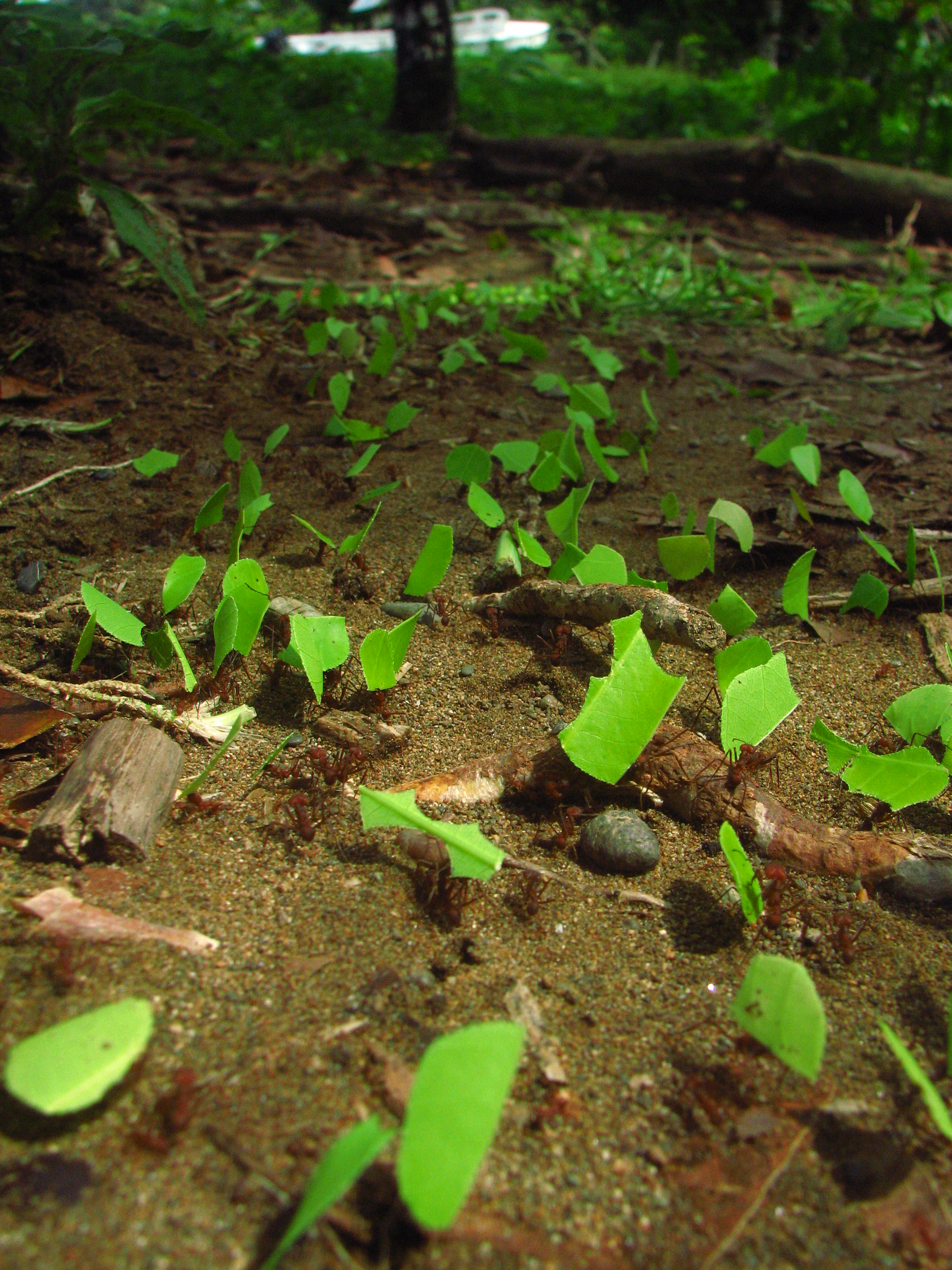
Some types of leafcutter ants are gardeners. They cut up pieces of fresh leaves and take them back to their nest. They chew up the leaves and then use the paste as a fertilizer on which they grow fungi that is their main food source. Other types of ants are farmers, tending 'cattle' in the form of aphids (small insects). The ants guard the aphids and continually move them to fresh areas of plant growth, which the aphids eat. The aphids then give off a sugary secretion which the ants eat. Stunning to find such multi-step intelligence from such tiny creatures. And these are just a few of many examples from the ant world. If you're at all curious about ants, I highly recommend this book.

Wilson and Holldobler, aside from being two of the most respected myrmecologists in the world, are also very thoughtful writers. Their final two paragraphs offer some humbling perspective on the respective roles that humans and ants play for life on Earth:

"If all of humanity were to disappear, the remainder of life would spring back and flourish. The mass of extinctions now under way would cease, the damaged ecosystems heal and expand outward. If all the ants somehow disappeared, the effect would be exactly the opposite, and catastrophic. Species extinction would increase even more over the present rate, and the land ecosystems would shrivel more rapidly as the considerable services provided by these insects were pulled away.

Humanity will in fact live on, and so will ants. But humankind's actions are impoverishing the earth; we are obliterating vast numbers of species and rendering the biosphere a far less beautiful and interesting place for human occupancy. The damage can be fully repaired by evolution only after millions of years, and only then if we let the ecosystems grow back. Meanwhile let us not despise the lowly ants, but honor them. For a while longer at least, they will help to hold the world in balance to our liking, and they will serve as a reminder of what a wonderful place it was when first we arrived."

Wednesday, March 11, 2009

Carbon Calculations and Offsets

While I think it's important to reduce our use of fossil fuels, we still live in a society that is entirely dependent on those fossil fuels. And we have to live our lives. This means that sometimes we are going to do things that are not ideal environmentally.

Case in point: this autumn, I'll move somewhere to begin graduate school, and I think it's important to see the schools and their surrounding areas before making the decision of where to go. I love road trips, so my first thought was to go by car. But that struck me as a lot of fuel to use up for one person.

My next thought was trains. I love long train trips, which often pass through amazingly beautiful places that you can't get to on roads. But after spending some time on Amtrak.com, I found that the trains are longer than I had thought--the longest would be about a 72 hour trip. Yikes!

So then I checked planes, which turned out to be the fastest and cheapest option by far. Definitely not as fun as trains, but when you can pay $200 (not including food) for 72 hours on a train or $110 for 6 hours on a plane, it's tough to choose the train.

But aren't planes terrible for the environment? I wanted to know what my carbon footprint would be with these various forms of transportation.

I ended up at CarbonFootprint.com, where I was able to calculate the carbon footprint of my potential itineraries. (They state that their US data comes from the Environmental Protection Agency and the Department of Energy.)

Here was the breakdown of doing the trip by:

Train = 1.06 tonnes of CO2

Plane = 1.14 tonnes of CO2

Car = 3.66 tonnes of CO2

I was a little bit surprised by how much worse car is than the others (though it wouldn't be so bad if I wasn't going solo). But what really surprised me most was that plane and train were so similar. I've always thought of trains as being much better, but apparently they're only a little better.

Looking at these numbers, I think I'll probably take two planes and a train. But that will still leave me producing about 1.16* tonnes of CO2. What about that? (*This is higher than the 1.14 above, because the train I'll take, Denver to Seattle, is actually slightly more carbon than the same route by plane, because it goes all the way west to Sacramento before going north.)

I originally went to CarbonFootprint.com to calculate my carbon emissions, but it turned out that their main function is selling carbon offsets. "Carbon offset" means that I donate to an organization whose activities will reduce CO2 by roughly the same amount that my activities have increased CO2. The idea behind this is to generate funding for organizations that are doing good things for the environment and to create a market for carbon offsets that will provide a financial incentive for companies to lower their CO2 emissions.

So my 1.16 tonnes of CO2 have been offset by $14.84 given to an organization that is planting Maya Nut trees to reforest parts of Central America. Pretty neat.

Btw, in case you, like me, have an inner cynic, and wonder how we can know that the $14.84 will actually go towards planting trees, it seems there are efforts underway to regulate the carbon offset industry. For example, the British government has started a program to oversee and certify carbon offsetters, the Quality Assurance Scheme for Carbon Offsetting, and CarbonOffset.com is one of the first to receive approval. For more on purchasing carbon offsets, check out this great wiki: How to Buy a Carbon Offset.

The idea of carbon offsets is relatively new, and nobody really knows yet if it will work. There are certainly strong opinions on both sides of the matter. The Wikipedia entry on the subject gives a good overview: http://en.wikipedia.org/wiki/Carbon_offsets.

For my part, I like this first experience. It's something of an easing of my conscience for the emissions of my travel, which is kind of selfish, but it also invests money in what are hopefully good projects. And it provides incentive for us to be more aware of how our actions emit CO2 and to do something positive about it.

If you want to give it a try, here's the flight portion of the carbon calculator from CarbonFootprint.com. The full version is here.

Monday, March 9, 2009

The Great Disruption

This is an excellent opinion piece from the New York Times. Perhaps we are collectively, on the level of the "mainstream," starting to understand how serious our problems are.

The Inflection is Near?


Published: March 7, 2009

Sometimes the satirical newspaper The Onion is so right on, I can’t resist quoting from it. Consider this faux article from June 2005 about America’s addiction to Chinese exports:

FENGHUA, China — Chen Hsien, an employee of Fenghua Ningbo Plastic Works Ltd., a plastics factory that manufactures lightweight household items for Western markets, expressed his disbelief Monday over the “sheer amount of [garbage] Americans will buy. Often, when we’re assigned a new order for, say, ‘salad shooters,’ I will say to myself, ‘There’s no way that anyone will ever buy these.’ ... One month later, we will receive an order for the same product, but three times the quantity. How can anyone have a need for such useless [garbage]? I hear that Americans can buy anything they want, and I believe it, judging from the things I’ve made for them,” Chen said. “And I also hear that, when they no longer want an item, they simply throw it away. So wasteful and contemptible.”

Let’s today step out of the normal boundaries of analysis of our economic crisis and ask a radical question: What if the crisis of 2008 represents something much more fundamental than a deep recession? What if it’s telling us that the whole growth model we created over the last 50 years is simply unsustainable economically and ecologically and that 2008 was when we hit the wall — when Mother Nature and the market both said: “No more.”

We have created a system for growth that depended on our building more and more stores to sell more and more stuff made in more and more factories in China, powered by more and more coal that would cause more and more climate change but earn China more and more dollars to buy more and more U.S. T-bills so America would have more and more money to build more and more stores and sell more and more stuff that would employ more and more Chinese ...

We can’t do this anymore.

“We created a way of raising standards of living that we can’t possibly pass on to our children,” said Joe Romm, a physicist and climate expert who writes the indispensable blog climateprogress.org. We have been getting rich by depleting all our natural stocks — water, hydrocarbons, forests, rivers, fish and arable land — and not by generating renewable flows.

“You can get this burst of wealth that we have created from this rapacious behavior,” added Romm. “But it has to collapse, unless adults stand up and say, ‘This is a Ponzi scheme. We have not generated real wealth, and we are destroying a livable climate ...’ Real wealth is something you can pass on in a way that others can enjoy.”

Over a billion people today suffer from water scarcity; deforestation in the tropics destroys an area the size of Greece every year — more than 25 million acres; more than half of the world’s fisheries are over-fished or fished at their limit.

“Just as a few lonely economists warned us we were living beyond our financial means and overdrawing our financial assets, scientists are warning us that we’re living beyond our ecological means and overdrawing our natural assets,” argues Glenn Prickett, senior vice president at Conservation International. But, he cautioned, as environmentalists have pointed out: “Mother Nature doesn’t do bailouts.”

One of those who has been warning me of this for a long time is Paul Gilding, the Australian environmental business expert. He has a name for this moment — when both Mother Nature and Father Greed have hit the wall at once — “The Great Disruption.”

“We are taking a system operating past its capacity and driving it faster and harder,” he wrote me. “No matter how wonderful the system is, the laws of physics and biology still apply.” We must have growth, but we must grow in a different way. For starters, economies need to transition to the concept of net-zero, whereby buildings, cars, factories and homes are designed not only to generate as much energy as they use but to be infinitely recyclable in as many parts as possible. Let’s grow by creating flows rather than plundering more stocks.

Gilding says he’s actually an optimist. So am I. People are already using this economic slowdown to retool and reorient economies. Germany, Britain, China and the U.S. have all used stimulus bills to make huge new investments in clean power. South Korea’s new national paradigm for development is called: “Low carbon, green growth.” Who knew? People are realizing we need more than incremental changes — and we’re seeing the first stirrings of growth in smarter, more efficient, more responsible ways.

In the meantime, says Gilding, take notes: “When we look back, 2008 will be a momentous year in human history. Our children and grandchildren will ask us, ‘What was it like? What were you doing when it started to fall apart? What did you think? What did you do?’ ” Often in the middle of something momentous, we can’t see its significance. But for me there is no doubt: 2008 will be the marker — the year when ‘The Great Disruption’ began.