Friday, June 26, 2009

Growing Veggies (Update)

On May 26, I posted about "Growing Veggies." At that time, the garden was just starting to take shape and nothing was ready to be eaten. What a difference a month makes...

This was taken a few days ago:

In the front right, with the yellow flowers, is zucchini. Immediately behind that is daikon, and behind that is sweet peppers, chili peppers, basil and goya (aka bitter melon). To the right of goya is corn and cauliflower. To the left of the zucchini is a row of morning glory (aka water spinach), the dark green chijimina (similar to bok choy) and behind that is more morning glory. To the left of that row is eggplant, tomato, cucumber and spinach (in the back).

Here is Ayumi with a few days worth of zucchini:


Here's another angle on the veggies:

From front to back: spinach; water spinach; (L to R) goya, basil, chili pepper, sweet pepper; corn and one of the eight cauliflowers.

This has been an awesome experience for me. Watching the plants grow has been magical. And it's a wonderfully enjoyable culinary experience to pick fresh, pesticide- and herbicide-free plants outside your home and to be eating them within the hour. For one, the food tastes great--fresh, delicious, full of life. But also, it's very gratifying to be feeding ourselves food that we know is so healthy.

And it was really pretty easy to do. In fairness, my father-in-law, an experienced grower, was doing all this with us, so that helped. But it was all fairly straight-forward. This is what went into it:

First, my father-in-law used a machine to mix up the soil and plow it into rows. Ayumi and I then spent a few hours forming the rows and smoothing the surface. My father-in-law then applied small amounts of chemical fertilizer (he composts, but the compost was not sufficient by itself--in the future, I hope to learn how to grow veggies 100% organic) and we waited a week. Then we planted seeds and seedlings. We've watered them daily since then. Once every few weeks we've had to pull out weeds by hand. And a few times we sprayed charcoal vinegar (a natural insecticide) to discourage some little bugs who were eating the young zucchini and chijimina leaves. So it hasn't really taken up that much time, and what time we have spent (watering, weeding, etc.) has been really enjoyable and relaxing.

It's about 6pm here, the sun has just gone down below the hills behind the house, so it's time to water the plants. Then I'll harvest something for dinner. I think tonight we'll use moning glory, chijimina and zucchini. Mmmm.....

Monday, June 15, 2009

Food Inc.

"The way we eat has changed more in the last fifty years than in the previous ten thousand."

This is the opening line of a new documentary on how food is produced in the United States, focusing particularly on the industrial food system. I've touched on this issue in previous posts (see: "Support Organic", Dec. 19, 2008; "Organic: Good for Earth", Feb. 3, 2009), and I think it is extremely important.

The way we in the industrial world produce food is unsustainable, destructive to the environment and yields food of dubious nutritional value whose main virtue is that it's cheap. This system is excellent economically (at least if you don't take into account the money spent treating obesity, diabetes, heart disease, etc., and the costs of pollution of streams, rivers, lakes, the Gulf of Mexico, the air, etc.) but it is terrible in every other way. It persists, I believe, primarily because most people don't know the facts about it. If every person in the United States spent just one single day educating themselves about how our food is produced, that would be enough to bring about massive changes. The facts are powerful and overwhelming.

At least that's how it looks to me. You might disagree. But either way, you owe it to yourself to be informed, because this issue is so important and so universal. This film looks like a great place to start.

Here is their excellent website, which is loaded with information: http://foodincmovie.com/

And here's the trailer:

Wednesday, May 27, 2009

Growing Veggies

What better way to reconnect with the land than to grow food! For years, I've been looking for an opportunity to grow some veggies, and this summer, living with my wife Ayumi's family in Japan, it's finally come. The city where we're living, Hofu (in Yamaguchi state), is fairly rural and many, many people grow their own vegetables, right out in their front yard. It's inspiring to see.

Ayumi and I have planted seeds for zucchini, ensai and chijimina (don't know the English names for the last two!). We're also helping her parents grow spinach, tomatoes, potatoes, onions, eggplant, okra, cucumber, bell peppers, chili peppers, goya (a Japanese vegetable), daikon (Japanese radish), lettuce, parsley, basil, garlic, koimo (a Japanese starch veg, similar to potato), watermelon and shiso (a Japanese herb).

There's something really magical about putting a tiny little seed into the ground and then watching the delicate buds push their way up and out through the soil, growing day by day into a big plant. Here are some pictures of what we've got so far:

April 27: Seeds for zucchini, ensai and chijimina have just been planted. Ayumi, in pink, surveys the land, while her mom, in blue, pulls weeds. The bubbles house young eggplant, tomato and cucumber plants.


May 2: Zucchini (top) and chijimina (bottom) are starting to emerge.


May 12: More sprouts emerging. Eggplant, tomato and cucumber are out of their bubbles. Starting to look like a real garden now.


May 22: Chijimina is starting to look like a real plant, though many of the seeds never sprouted, so we planted some more. Ensai, past the dark green chijmina, is having trouble (I think we planted the seeds too deep--learning as we go!), so we planted some more seeds. On the right are the zucchini. Behind them is the daikon.


May 27 (today): The zucchini (first pic) are starting to get big. Even the ensai (second pic) are growing well now. The garden is getting greener every day.


Monday, April 27, 2009

Journey to the Ants

As I like to learn more about the other creatures with whom we share this planet, I recently read a book about ants, Journey to the Ants, by Bert Holldobler and Edward O. Wilson. It's a 200-page adaptation for the general public of their 700+page 1991 Pullitzer Prize-winning tome, Ants.

Ants are fascinating! Although they are tiny little creatures, they engage in a wide variety of intelligent, complex behaviors that we typically associate only with humans. For example, many ant colonies intentionally wage wars against neighboring ant colonies. First, they send out scouts who locate the enemy. After marking the enemy's location, the scouts return to the nest for reinforcement by the 'soldiers,' who are larger ants of the same species that are more aggressive and better suited for fighting (check out this picture--the solider is on the right--notice the spikes on his back--yikes!). Then they pour out en masse and swarm the enemy. In addition to waging wars, some ants make raids of other ant colonies not to fight a big battle but to steal in and take hostages that they will turn into slave laborers.

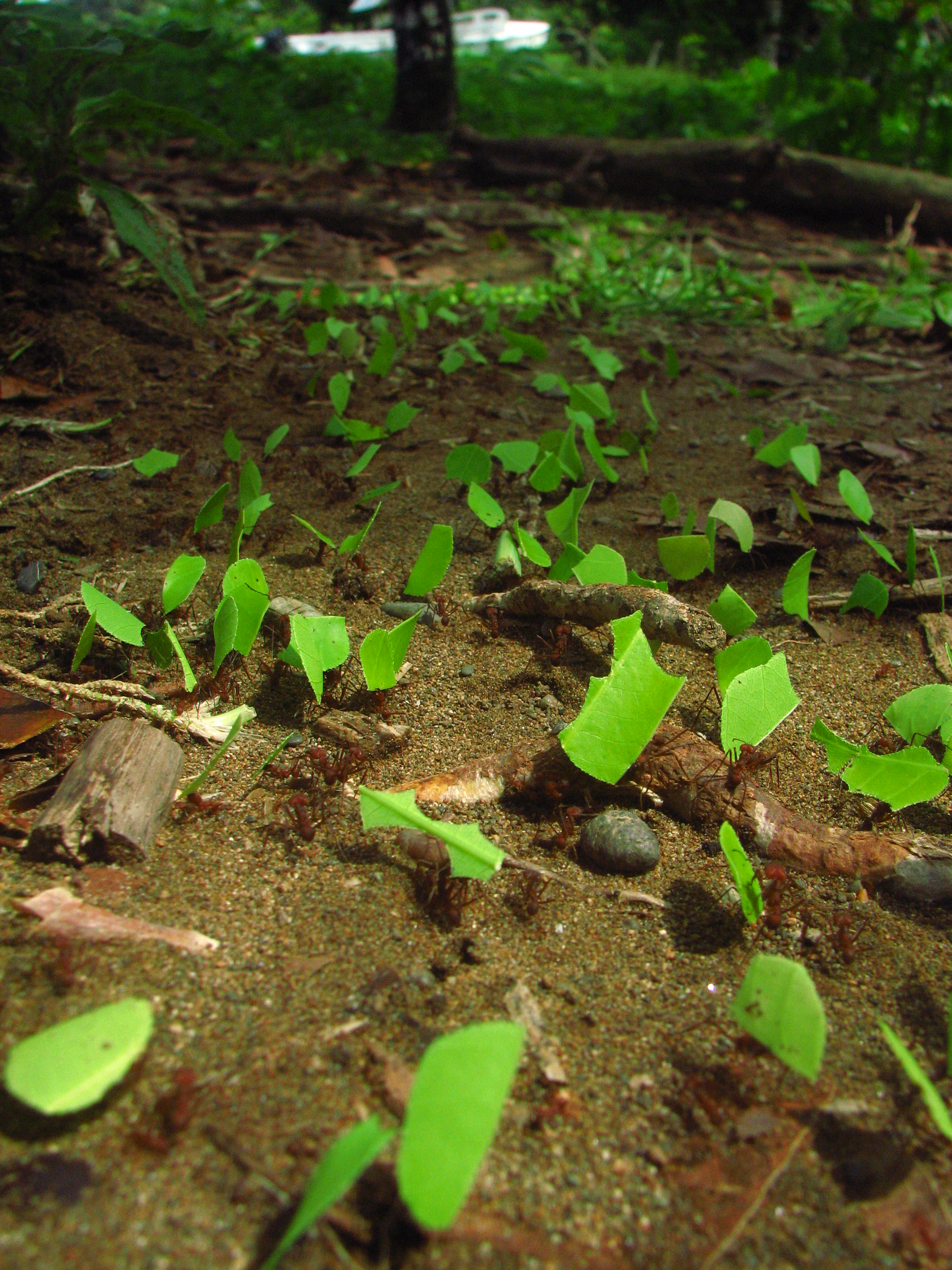
Some types of leafcutter ants are gardeners. They cut up pieces of fresh leaves and take them back to their nest. They chew up the leaves and then use the paste as a fertilizer on which they grow fungi that is their main food source. Other types of ants are farmers, tending 'cattle' in the form of aphids (small insects). The ants guard the aphids and continually move them to fresh areas of plant growth, which the aphids eat. The aphids then give off a sugary secretion which the ants eat. Stunning to find such multi-step intelligence from such tiny creatures. And these are just a few of many examples from the ant world. If you're at all curious about ants, I highly recommend this book.

Wilson and Holldobler, aside from being two of the most respected myrmecologists in the world, are also very thoughtful writers. Their final two paragraphs offer some humbling perspective on the respective roles that humans and ants play for life on Earth:

"If all of humanity were to disappear, the remainder of life would spring back and flourish. The mass of extinctions now under way would cease, the damaged ecosystems heal and expand outward. If all the ants somehow disappeared, the effect would be exactly the opposite, and catastrophic. Species extinction would increase even more over the present rate, and the land ecosystems would shrivel more rapidly as the considerable services provided by these insects were pulled away.

Humanity will in fact live on, and so will ants. But humankind's actions are impoverishing the earth; we are obliterating vast numbers of species and rendering the biosphere a far less beautiful and interesting place for human occupancy. The damage can be fully repaired by evolution only after millions of years, and only then if we let the ecosystems grow back. Meanwhile let us not despise the lowly ants, but honor them. For a while longer at least, they will help to hold the world in balance to our liking, and they will serve as a reminder of what a wonderful place it was when first we arrived."